
The secret to smarter teams? How you connect them, says Dr. Centola in new book

How can we accelerate individual and collective intelligence?
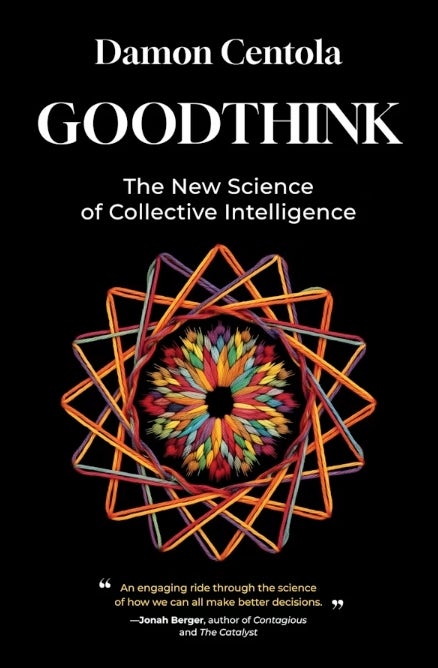
CHIBE affiliate Dr. Damon Centola has a new book out called: Goodthink: The New Science of Collective Intelligence, which gives behind-the-scenes details of the most successful systems of collective intelligence.
Dr. Centola is the Elihu Katz Professor of Communication, Sociology and Engineering at the University of Pennsylvania and a 2026 Guggenheim Fellow.
Read CHIBE’s Q&A with Dr. Centola below about his new book, which comes out October 13.
Your new book Goodthink talks about how to improve collective intelligence. What advice would you give CHIBE – how should we be building our teams, or do you have any tips for our new office space since we just moved into a new building?
One of the big lessons of Goodthink is that increasing information can slow down innovation. We tend to assume that if we want smarter, more creative teams, we should connect everyone to everyone else and make information flow as quickly as possible. But for complex problems, that can actually make people converge too quickly on the same ideas.
One of my favorite examples is MIT’s legendary Building 20. It brought together researchers from very different disciplines, and its long, confusing hallways created repeated encounters among people who otherwise might never have interacted. It combined intellectual diversity with repeated local interaction, and that turned out to be an incredibly productive environment for innovation. At the same time, Building 20 was relatively disconnected from the broader MIT community and from researchers’ home departments. That separation mattered: it gave unconventional ideas room to develop without immediately being crowded out by more established approaches.
My team and I found something similar experimentally. We put data scientists into teams solving complex statistical problems. When everyone could see everyone else’s work, the teams quickly converged on good solutions. When people could see only a few nearby peers, ideas spread more slowly, so people kept exploring different parts of the problem. Those locally connected teams were much more likely to discover exceptional solutions – often finding rare optimal solutions.
So for CHIBE, especially in a new space, I’d think about creating opportunities for serendipity without forcing too much connectivity. Think about structuring hallways with an eye to who will run into whom. Will people from different research areas naturally cross paths? Can you create local research clusters where people interact repeatedly, while still bringing new people and perspectives through those spaces?
The goal isn’t maximum information. It’s finding the right balance between interaction and independence, so that people can learn from one another without converging too quickly on the same ideas.
Could you tell us about how “herding behavior” can make crowds more intelligent?
We normally think of herding as a bad thing: people see what’s popular, follow everyone else, and stop thinking for themselves. However, popularity can be its own kind of intelligence. The key to collective success is to share people’s choices in a way that helps others to explore interesting new options.
One of the studies I discuss in Goodthink is the MusicLab experiment. Nearly 7,000 teenagers listened to songs by unknown bands. Some made their choices independently, while others could see what previous listeners were downloading.
One song, “She Said” by the band Parker Theory, emerged as a favorite when people chose independently. The researchers then deliberately manipulated the rankings: they put that song at the bottom of the Billboard rankings and pushed the least popular songs to the top.
If people simply followed the herd, those false rankings should have become self-reinforcing. But that’s not what happened. As more people listened and made their own choices, the rankings began correcting themselves, and “She Said” climbed rapidly back toward the top. Social influence didn’t impede this self-correcting process, it accelerated it.
What’s happening is that social feedback can act as a search tool. Imagine trying to choose among thousands of songs you’ve never heard. You can’t realistically evaluate every option yourself. Seeing what other people have discovered provides a signal about which options may be worth exploring and directs your attention toward promising possibilities. You still make your own judgment about whether you like what you find, but you’re benefiting from the discoveries of everyone who came before you.
That’s how individual choices can accumulate into collective intelligence. Each person’s experience leaves behind a widening trail of breadcrumbs that helps others navigate the available options, making the collective search more efficient.
But there’s an important catch: this only works when all of the alternatives remain available long enough to be discovered. If unpopular options are eliminated too quickly, an early mistake can become self-reinforcing. That’s when “herding” becomes a problem. For instance, if Harry Potter had disappeared after being rejected by 12 publishers – before finally getting picked up by lucky publisher number 13 – readers would never have had the opportunity to discover it. Or if “She Said” had been culled from the list when it was at the bottom, before it made its way back to number 1.
Herding is intelligent when options are not artificially culled from the scene. Social feedback doesn’t have to lead to herding off a cliff. When individuals can learn from the crowd while still evaluating alternatives for themselves, social influence can help the group discover good options far more efficiently than individuals searching alone.
What is one thing you hope readers will do differently after reading your book?
I hope they’ll stop asking only, “Who are the right people to put in the room?” and start asking, “How should we connect them?” We spend an enormous amount of time selecting talented people, assembling expert teams, and trying to communicate the right information. But Goodthink shows that the structures connecting those people can be just as important as who is on the team.
The same group of people can become more accurate or less accurate, more creative or more conformist, more cooperative or more divided, depending on how information and influence move through the group.
One of the ideas I introduce in the book is what I call “structural intelligence”: the ability to adapt the structure of a network, and the flow of information through it, to the kind of problem a group is trying to solve. There isn’t one ideal way to connect people. If you’re trying to improve accuracy, you may want influence distributed evenly so that no single voice dominates. If you’re trying to foster coordination, you may need to centralize social influence to help everyone quickly rally around a shared focal point. However, if you’re trying to generate creative breakthroughs, you may instead want information to move more slowly, giving different ideas time to develop before everyone converges on the same approach.
So whether you’re designing a research team, a meeting, an organization, or even an office, I’d like people to start by asking: Which problem are we trying to solve – choosing, creating, coordinating or cooperating? Then design the network around that problem. Who should interact with whom? How quickly should information spread? Where should influence be concentrated or distributed? And do people need enough independence to keep exploring different ideas?
That’s really the central idea of Goodthink: Social influence can be our best ally, if only we understand how to structure it. When we adapt that structure to the problem we’re trying to solve, we can design networks that help people learn from one another, make better decisions, cooperate more effectively, and solve problems that none of us could solve alone.